Students

Colorado School of Mines is a uniquely focused public research university dedicated to preparing exceptional students to solve today's most pressing energy and environmental challenges.

This is Mines.

By Taylor Polodna
The Oredigger

A group of Mines students, representing Engineers Without Borders-USA (EWB-USA), travelled down to Nicaragua to the small community of Los Gomez to complete a pedestrian footbridge over the frequently flooded Rio Ochomogo River.

The bridge had been under construction for the preceding year. The cohort included six students, a faculty mentor, and a professional mentor, ranging in majors from civil to humanitarian to chemical engineering, all of whom donated their spring reaks to helping those less fortunate than themselves. The trip marked the 4th trip to the small community over the last year in which the team was able to finish hand mixing and pouring two concrete anchors, stringing five steel cables, and laying the decking and fencing of the 42 meter pedestrian footbridge.

EWB-USA Mines is a student led campus club that focuses on sustainable development of communities outside of the US with six core values: integrity, service, collaboration, ingenuity, leadership, and service. In addition, the club participates at a local level in a variety of on-campus and off-campus events including Relay for Life, Up 'Til Dawn, and many Habitat for Humanity builds.

Barbara Anderson, a graduating senior in Civil Engineering recounts her experience toward the end of the bridge completion. "As we began putting the decking on the bridge we were able to muster a lot of community support and could tell that the community members, even the ones that didn't come to worksite, were getting excited for their bridge to be completed. Kids would walk by on their way home from school and just watch us work on the bridge for hours and, as soon as we left, would play on it. At the end of the week, we had an opening ceremony for the bridge with the whole community. It was an awesome experience to see all the people that had worked with us, fed us, and welcomed us into their homes gather together and celebrate the success of their project."

Read the rest of the story on The Oredigger website.

A group of current and former Mines students traveled to Rio de Janeiro, Brazil, over spring break to work on home construction and in the schools of area favelas (slums). 

“Our main project was to build relationships within Complexo do Alemao,” said David Pesek, Mines graduate and co-founder of The Invictus Initiative, a group aimed at tackling global humanitarian causes. “Each day was different and filled with great experiences. We feel it was a successful trip and built sustainable relationships within the community.”

Pesek and his group will showcase the Rio trip; as well discuss their upcoming trip to Kenya, at 6 p.m. March 25 in Ballroom A of the Student Center. 

Learn more and see additional photos of their work in Brazil on their blog.


From the intellectual to the adventurous, students employed by Mines report that, along with a paycheck, their work provides balance, fun and intellectual stimulation. Having access to a deep pool of driven, high-achieving young men and women is good for Mines, too.

Scooping ice cream or flipping burgers is honorable work for a college student, but some of the job opportunities for Colorado School of Mines students offer a lot more, kick-starting careers, forging community connections and pushing phyical limits. On a headcount basis, more than 60 percent of the individuals employed at Mines are students (40 percent undergraduates), and while most may work only a few hours per week, their cumulative contribution to campus operations is substantial. Interested in finding out which undergraduates had the best gig, we took a survey. Here we bring you our top five and comments from others who caught our attention.

1. Outdoor Recreation Center climbing wall route setters

Andrew Lee, sophomore
Field of study: Chemical engineering

Brandon Conaway, sophomore
Field of study: Geological engineering

When they’re done solving problems in their calculus classes, Andrew Lee and Brandon Conaway head to the Student Rec Center and invent problems for others to solve—climbing problems. “This job puts you in an environment where you can be creative,” says Conaway. “It gives you the opportunity to set routes that challenge your abilities and other students. I think my favorite part, though, is watching people who have never rock climbed before come in and have a blast.”

Lee, who’s the head route setter, has climbed for 12 years. “I get to spend a lot of time getting paid to do what I do best,” he says. “I also get to climb all the other setters’ problems and tweak them if they need to be adjusted.” When asked for his strategy in establishing routes, Lee doesn’t hesitate: “As an experienced climber, you know what’s next; it’s natural. You start with a move or hold and then devise a set of movements to go into it. It just flows. It’s an art form.”


2. Research assistant in the Colorado Fuel Cell Center

Hailey Meyer, first-year sophomore
Field of study: Chemistry and chemical engineering

If Hailey Meyer is the future of renewable energy, we have little to worry about. “Thursdays are my favorite—that’s the day that I work,” she gushes with palpable enthusiasm. She’s at Mines because of the Harvey Scholars Program, which she was invited to apply for last summer while in Spain (“that was an adventure and a half, trying to find an English word processor to write my essay”), and is creating polymers, learning about zero-emission anion-exchange fuel cells that use rock minerals as a catalyst instead of precious metals, and worrying about research funding drying up. Meyer landed a dream job working in renewable energy thanks to work-study funds and a connection she made through a Society of Women Engineers Evening with Industry event last September. “I hope NREL hires me some day,” she confides. “It’s comforting to know that I have a network now. I am one of the lucky ones to find what I am passionate about so early in my college career.”


Read more on the Mines Magazine website. (This story appeared in the Spring 2013 issue.)


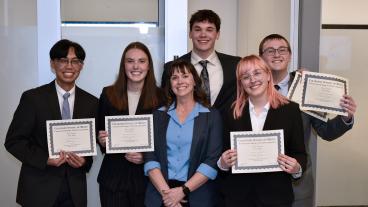
The Fifth International Design Competition and Forum held earlier this year as part of a research initiative between Colorado School of Mines and The Petroleum Institute, of Abu Dhabi, UAE, aimed to develop curriculum and pedagogy for engineering design education across cultures.

The forum, “Preparing Global Engineers: Developing Engineering Design Education Across Cultures,” allowed students in Mines’ EPICS program and the PI’s Strategies in Team-Based Engineering Problem-Solving (STEPS) program to compete in a 24-hour competition during which students developed a project plan, graphics portfolio and poster supporting its conceptual design.

Awards were presented to teams exhibiting outstanding creativity, functionality, and quality:

  • Best Quality Project: Team Dynamic, for Micro-Hydro Energy System: Razi Ur Rehman, Martin Oliver Fernandes, Yahya Almuharram, Ahmad Ali Alamimi (PI), Edward Wolfram (Mines)
  • Most Creative Project: Team WIM, for Independent Patient Transfer System: Khulood AlMarzouqi, Dana AlShami, Fatima AlHashemi (PI), Emily Mitchell, Kara Davis, Amalina Abduh (Mines)
  • Best Humanitarian Project: Team S&S, for Indoor Farm for Low Income Communities: Isaac Sujay, Ala Salaoudh, Raed Saleh Mohammed Bamardoof, Anas AbuDaga (PI), Jesse Reigle, (Mines)

A new, permanent refuge chamber for Colorado School of Mines’ Edgar Experimental Mine is the latest in mine safety rescue technology and training.

The MineARC Refuge Chamber is capable of sustaining as many as 20 people for 36 hours in relative comfort while waiting for rescue if access to the surface is prohibited. It includes air filtration systems, climate control, food and water, and oxygen as well as medical supplies and communications equipment.

The chamber, supplied by MineARC, Inc., was installed and tested last December. Student and Harrison Western co-crews completed underground construction.

“The new refuge chamber is state-of-the art in refuge chamber technology, and will be used to train both students and industry personnel in keeping trapped miners alive in an underground environment,” said Bob Ferriter, mine safety and health program coordinator. 

About the Edgar Experimental Mine:

The Edgar Mine is a footnote to Colorado’s rich mining history. In the 1870s, it produced high-grade silver, gold, lead and copper. Today, as an underground laboratory for future engineers, it produces valuable experience for those who are being trained to find, develop and process the world’s natural resources. In this underground laboratory, Mines students gain hands-on experience in underground mine surveying, geological mapping, rock fragmentation and blasting, mine ventilation field studies, rock mechanics instrumentation practice, underground mine unit operations and mine safety.


Colorado School of Mines kicked off Delta Days, a week celebrating and promoting diversity, January 21.

The week began observing Martin Luther King, Jr. Day with a faculty and staff breakfast. At the event, three members of the Mines community were honored for their efforts in enhancing diversity across campus: Maureen Durkin, director of policy and planning; Bruce Goetz, director of undergraduate admissions; and Clifford Sanden, undergraduate student in the Department of Petroleum Engineering.

The recipients of the MLK Day Recognition Award, as it is called, were selected with this criteria:

  • Developed an innovative program, policy, or activity which has enhanced diversity within the unit, department, or program.
  • Contributed distinctively to fostering understanding and respect for diversity within the campus community.
  • Demonstrated a commitment to a philosophy of inclusion by initiating positive interactions between persons of different cultural backgrounds.
  • Demonstrated outstanding progress or achievement in one or more of the four priorities of the President’s Diversity Initiative which include: campus climate, broaden and deepen faculty diversity, increase female student enrollment, and increase underrepresented minority enrollment.

Dr. Winston Grady-Willis, professor and department chair of African and African American Studies at Metropolitan State University of Denver was a guest speaker at the event. Dr. Winston Grady-Willis earned a BA in history from Columbia, an MPS in Africana Studies from Cornell, and a PhD in history from Emory. Prior to coming to MSU Denver he was director of intercultural studies and associate professor of American studies at Skidmore College in Saratoga Springs, New York. While at Syracuse University, where he taught and labored in the Department of African American Studies, he received the Meredith Teaching Recognition Award. His book, "Challenging U.S. Apartheid: Atlanta and Black Struggles for Human Rights," 1960-1977 (Duke), seeks to provide a gendered examination of the contemporary black freedom movement. His articles have appeared in Presence Africaine, The Black Panther Party Reconsidered and Black Prison Movements, USA.

For a full list of Delta Days events, click here.


National Public Radio (NPR) Foreign Correspondent Deborah Amos shared experiences and insights from covering the Arab Spring in a special lecture of the Hennebach Program in the Humanities at Colorado School of Mines, Jan. 17, 2013.

Amos’ lecture, “The Arab Spring and Islamism: Stories from the Syrian Frontline," is especially timely given the civil war in Syria and its potential impacts worldwide.

Amos also spoke at the University of Colorado Boulder on Wednesday, Jan. 16, 2013. Her appearances were jointly sponsored by the Center for Media, Religion and Culture at the University of Colorado Journalism & Mass Communication program, and the Hennebach Program in the Humanities at Mines.

 “The Arab Spring is the largest geopolitical event to affect the Middle East since the end of the colonial era some five decades ago.  This popular movement succeeded in bringing about rapid regime change in some countries but has taken a more tortured path in Syria,” said Mirna Mattjik of the Hennebach program.  “Were the Assad regime to fall, it would have significant impacts on many countries in the region and on America’s interests there. Deborah Amos provides insights and analysis from her firsthand encounters.”

Nabil Echchaibi, director of CU’s Muslims in the Mountain West Project, welcomed the collaboration with the School of Mines to provide the public with timely and authoritative new information about the situation in Syria.

“The road to free rule in Syria has proven arduous and deadly,” Echchaibi said. “The unfolding tragedy in Syria today is a real litmus test for the resilience of authoritarian rule in Arab lands, and what happens there might have even larger repercussions for politics and U.S. interests in the region.”

As a journalist, Amos has been covering the Middle East for decades and has published two books on the region. Among her many accolades, Amos was recognized with the Edward Weintal Prize for Diplomatic Reporting from Georgetown University (2009) and was awarded the Edward R. Murrow Lifetime Achievement Award by Washington State University (2010). Since 2010, Amos has served as a Shorenstein Fellow at the Kennedy School of Government, Harvard University.


As it’s often said, the real world can be the best classroom. That’s precisely the idea behind an assignment students in Teaching Professor Chuck Stone’s ENGY 320 Renewable Energy course received: to individually design their own field trips to companies or organizations involved in renewable energy or sustainability and come back with a report.

“It was wide open,” said Stone as students showed off their posters and reports during the Forum on Renewable Energy at Colorado School of Mines, Dec. 6. “If I had told them what to do we wouldn’t have this depth and breadth of projects here. I was incredibly impressed with the variety and creativity.”

The field trips took students from solar companies to train stations and even elementary schools.

Senior Katherine Bony contacted engineers at Wheat Ridge based Major Geothermal learning how engineers at the company access heat energy from below the earth’s surface.

“I learned all about the different types of geothermal [systems]. I originally thought there was only vertical, but there’s horizontal, there are slinky loops. It all depends on the thermal conductivity of the ground,” said Bony.

Bony’s experience also led to an internship opportunity with the company.

Senior Kristen Heiden reported on her experience working with civil engineers working on the LEED certification for the Union Station redevelopment project in Denver.

“What I think is really neat is Union Station has a big waste management system,” said Heiden. “They use waste material to help in the construction, but they also recycle a lot of it.”

Heiden also learned how engineers are making the building greener by installing skylights, improving indoor air quality with large fans and planting gardens outside the station.

“It’s a great look at what we can look forward to as engineers when we’re actually designing things,” said Heiden.

Other projects showcased included a bike that measures electrical energy produced from pedaling. The project could be taken to middle and elementary schools as an interactive lesson about energy.

Stone’s ENGY 320 Renewable Energy class is part of the energy minor at Colorado School of Mines. For more information, click here.

Pages

Subscribe to RSS - Students